
In the manufacturing of contact assemblies for relays, contactors, and switches, the method used to fix the contact onto the plate (carrier or shunt) directly determines the product’s electrical and mechanical reliability. The two most prevalent processes are riveting (using solid or composite rivets) and welding (using contact pieces). This article provides a systematic comparison to guide your selection between riveting and welding processes for fixing contacts on a plate.
Ⅰ. Overview of the Two Processes
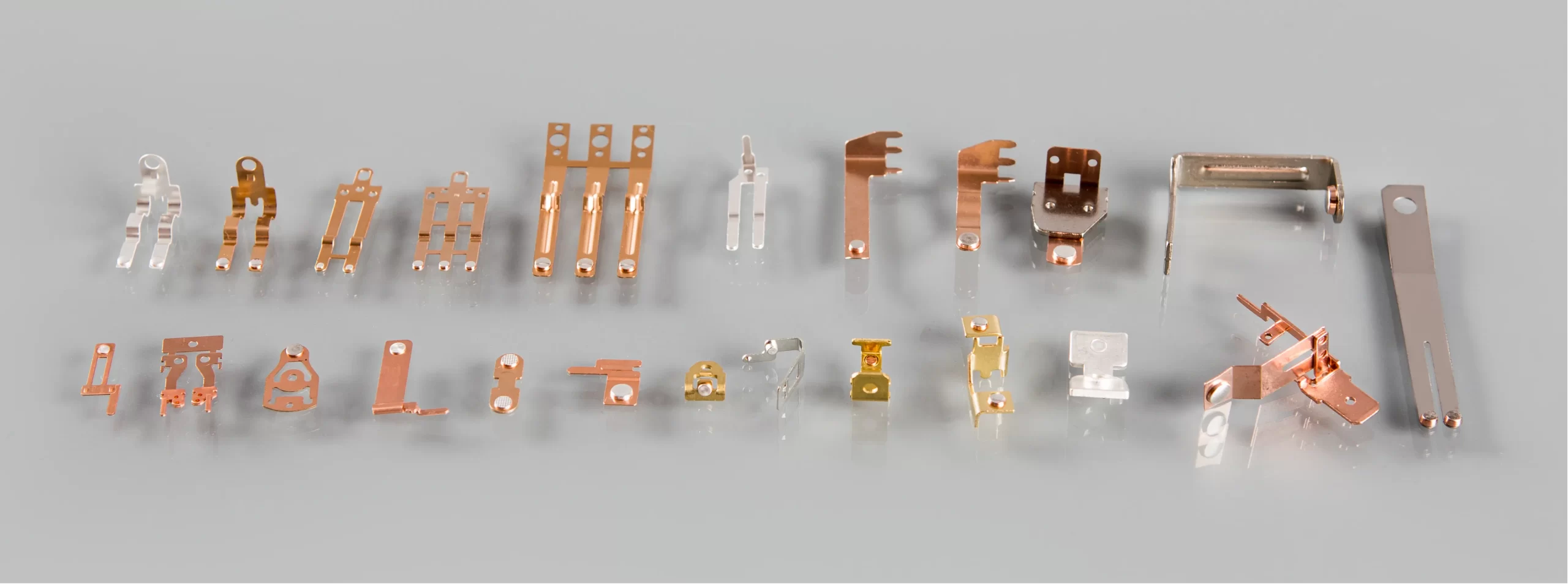
1.Riveting Process
This involves mechanically deforming a rivet contact(solid, bi-metal, or tri-metal) to lock it onto the plate. No melting occurs. It is a mechanical joint.
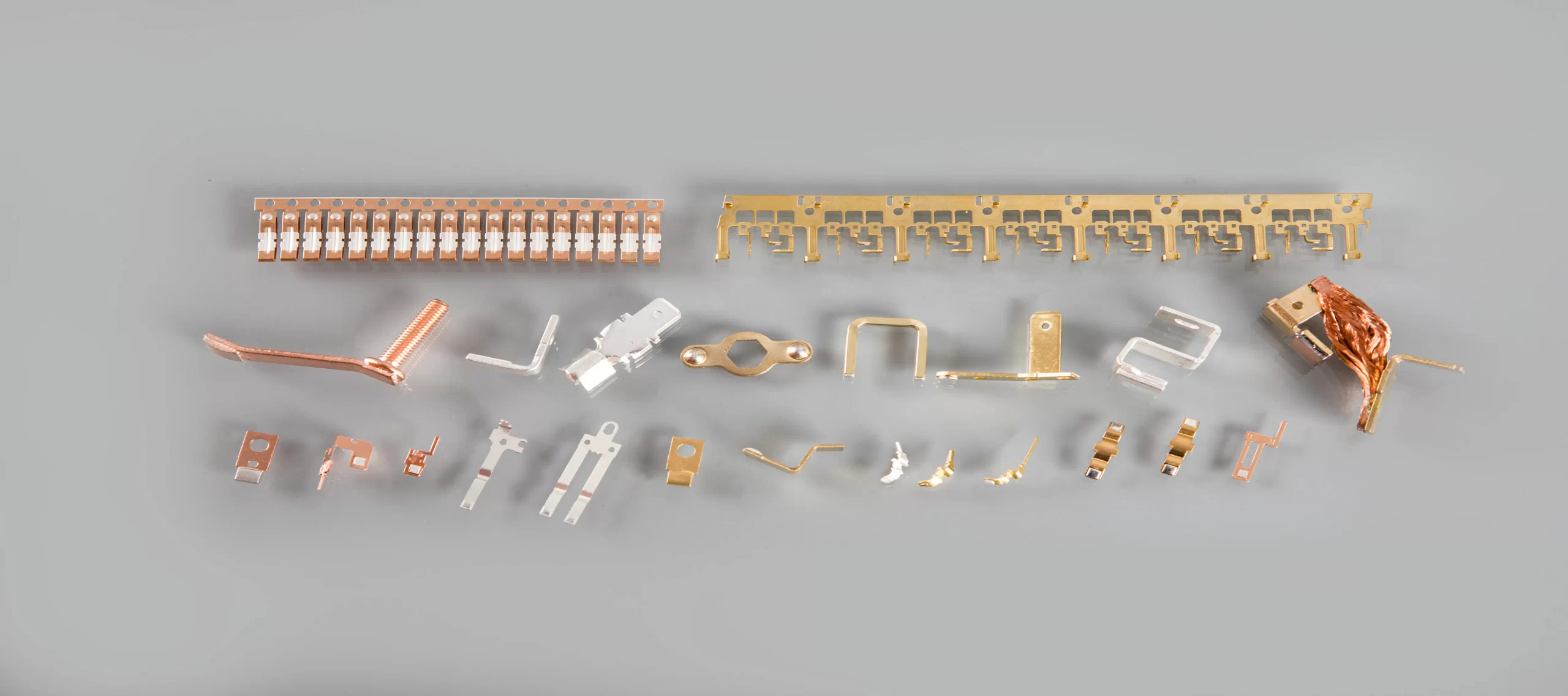
2. Welding Process
This typically uses resistance welding to join a contact piece(a flat sheet or pre-form) directly onto the plate. The materials at the interface melt and fuse, forming a permanent metallurgical bond.
 3. Comparison of Riveting vs. Welding on a Plate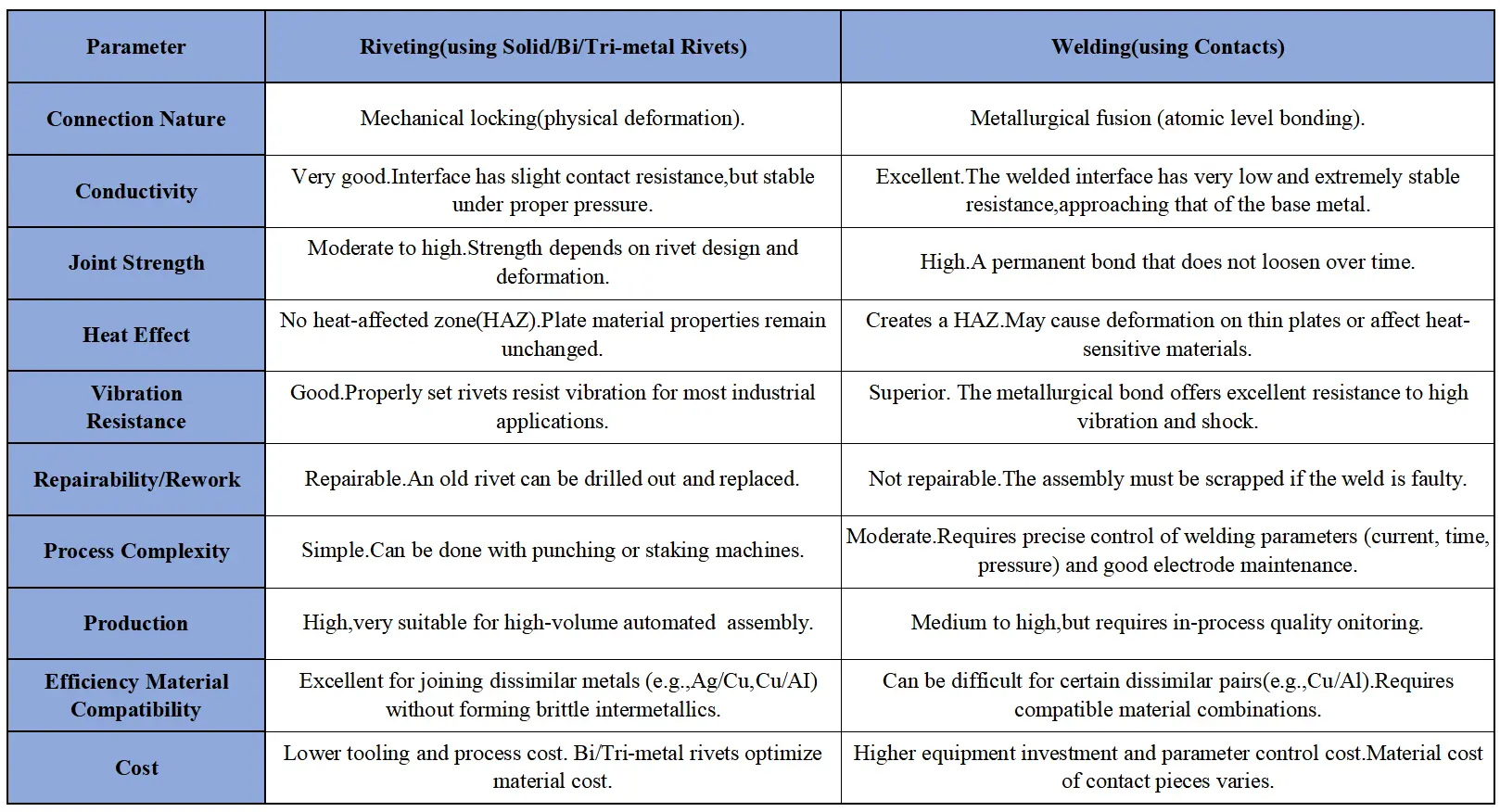
Ⅱ. Selection Recommendations
Choose the appropriate process based on your product’s specific requirements.
1.Prioritize Riveting(with Solid, Bi-metal, or Tri-metal rivets) when:
- Operating current is low to medium (generally ≤30A).
- Cost sensitivity is high, and you aim to reduce silver usage (use bi/tri-metal rivets).
- The plate is thin or made of heat-sensitive material to avoid thermal deformation or property change.
- Simple, high-efficiency production with the ability to rework is desired.
- Connecting dissimilar metals is required.
| Rivet Type | Structure | Key Feature | Typical Application |
| Solid Rivet | Homogeneous silver alloy (e.g., Fine Silver, AgNi) | Excellent conductivity, lowest and most stable contact resistance.Low-cost material but higher silver consumption. | Low-current signal relays, precision instruments (typically ≤10A). |
| Bi-metal Rivet | Ag-alloy working layer+Cu base | Reduces precious metal usage by >50%. Good weldability on the copper side. | General-purpose medium-current relays, contactors(10-30A).High cost-performance ratio. |
| Tri-metal Rivet | Ag-alloy+Cu+Ag-alloy(symmetric or asymmetric) | Optimizes materials for both stationary and moving contacts. Superior anti-welding and arc erosion resistance. | High-power relays, DC contactors, demanding applications(≥30A or high switching frequency). |
2.Prioritize Welding(with contact pieces) when:
- Operating current is high (>30A), and ultimate conductivity stability is required.
- The product will face intense vibration, mechanical shock, or high thermal cycling.
- The contact shape is complex and cannot be easily manufactured as a rivet.
- The highest possible joint strength is demanded, and a permanent, non-repairable assembly is acceptable.
- The production line has robust process control for resistance welding.
Ⅲ. Conclusion
The choice between riveting and welding for fixing contacts on a plate is not about one being universally superior, but about finding the optimal match for your specific electrical, mechanical, and economic requirements.
- Riveting offers a simple, cost-effective, and flexible solution for a wide range of medium to low-current applications, especially when using cost-saving bi-metal or high-performance tri-metal rivets.
- Welding provides the ultimate in joint strength and conductivity stability for high-current, high-reliability, or harsh-environment applications.
We have extensive experience in the field of contact assemblies, providing one-stop solutions from materials to processes for both riveted integral contacts and welded composite contacts. Please contact us for specific process parameter suggestions or sample testing!
Post time: May-08-2026