
Abstract
With the rapid development of electrical contact materials, silver-based contact materials remain highly valued for their excellent electrical conductivity. As low-voltage appliances trend toward high power, miniaturization, high frequency, and high reliability, the quality requirements for contact rivets have become increasingly stringent.
Unstable contact resistance often occurs after surface treatment, leading to rework, customer complaints, and performance failures. This paper by the SHZHJ R&D team distinguishes between mechanical scratch copper and chemical copper adhesion, identifies the root cause of chemical copper adhesion, and provides industrial solutions.
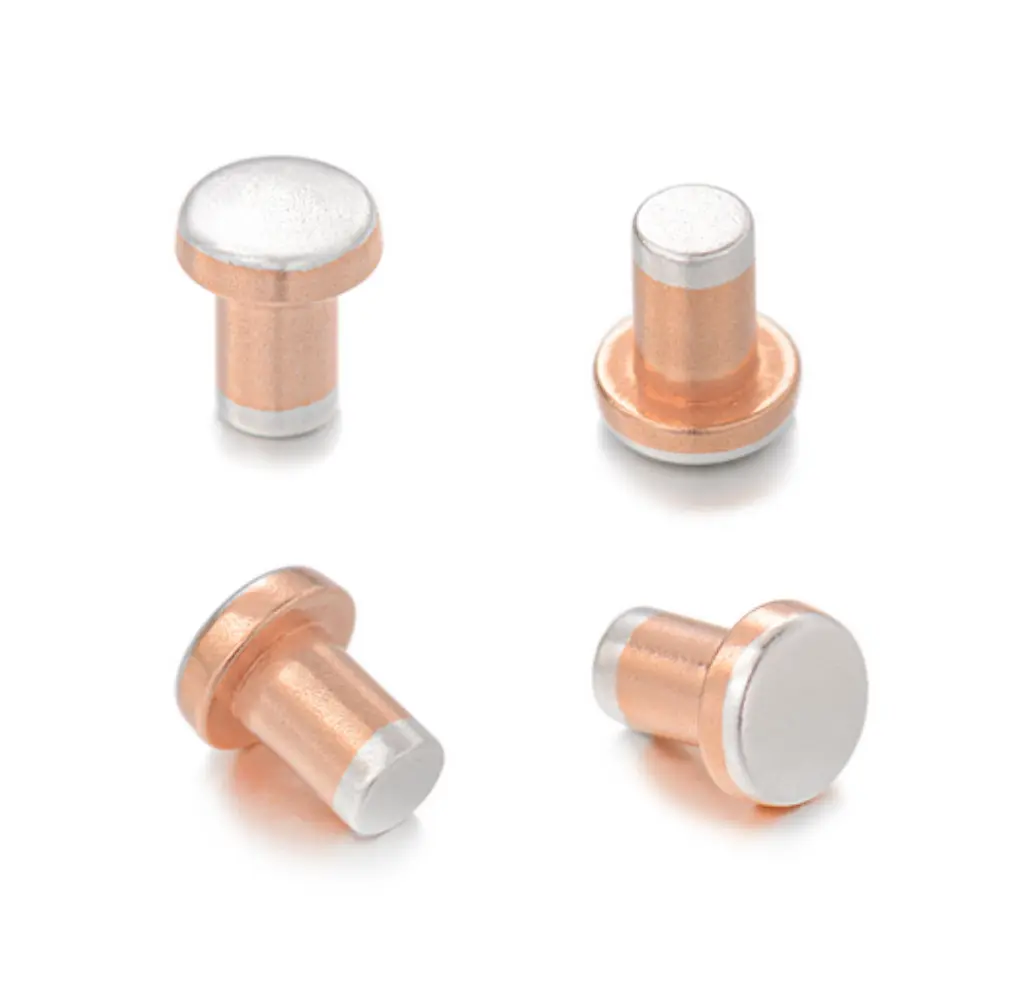
1 Two Types of Copper Adhesion and Their Effects
1.1 Mechanical Scratch Copper
- Microscopic copper powder, invisible to the naked eye
- Observed only at 400× magnification
- Coverage: approximately 0.1% of the working surface
- Effect: No obvious influence on contact resistance
1.2 Chemical Copper Adhesion
- Visible to the naked eye, observable at 50× magnification
- Coverage: 50% to 100% of the working surface
- Forms a continuous copper layer
- Effect: Significantly increases contact resistance and causes large fluctuations
Experimental results show that chemical copper adhesion increases contact resistance to 5–20 mΩ, severely affecting product stability and consistency.
2 Experimental Study and Root Cause Analysis
SHZHJ conducted a series of controlled experiments including:
- Sulfuric acid concentration gradients
- Copper ion concentration variations
- Different silver-based materials (AgNi, AgCdO, AgSnO₂)
- Mixed material placement
- Active metal contact and non-contact groups
Test Conclusions:
- Acid concentration does not cause adhesion
- Cu²⁺ alone does not cause adhesion
- Material type does not cause adhesion
- Mixed placement does not cause adhesion
True Root Cause: Galvanic Cell Reaction
Chemical copper adhesion occurs only when three conditions are satisfied:
- Electrolyte: Acid solution containing copper ions
- Electrodes: Silver surface (cathode) + active metal (anode, e.g., iron)
- Conduction: Direct physical contact between rivet and active metal
Iron dissolves and releases electrons, accelerating the deposition of copper ions onto the silver surface.
3 Industrial Solutions by SHZHJ
Based on this mechanism, SHZHJ has optimized post-treatment processes:
- Strict isolation of active metal impurities
- Enhanced cleaning and screening procedures
- Optimized acid bath management
- Full-process quality inspection
These improvements effectively eliminate chemical copper adhesion, reduce rework rate, and improve product yield.
4 Conclusion
Chemical copper adhesion is a critical defect caused by galvanic reaction, not mechanical damage. It significantly degrades contact resistance but is fully preventable through process control.
As a professional manufacturer of electrical contact materials, SHZHJ applies this research to all customized silver-based contact rivets, ensuring stable performance, high reliability, and consistent quality for global customers.
Contact SHZHJ
We provide full customization for all silver-based contact materials, including:
- AgSnO₂, AgNi, AgCdO, AgW, CuW series
- Custom rivets, contacts, and composite contacts
- Technical evaluation and sample support
Send your drawing or application requirements to get an official quotation within 24 hours.
Post time: Mar-17-2026