
In the fields of modern low-voltage electrical apparatus and automotive electronics, the bimetal composite rivet has become a precision fastening component widely used in relays, switches, contactors, and miniature circuit breakers, offering an excellent balance between economy and functionality. As the name suggests, a bimetallic composite rivet is an integrated rivet structure formed by combining two different metal materials through advanced cold-heading composite technology. Typically, its working face (i.e., the contact surface) employs a precious metal alloy with superior arc erosion resistance, such as silver-tin oxide (AgSnO₂), silver-nickel (AgNi), or silver-cadmium oxide (AgCdO), to ensure that the high-temperature arc冲击 during frequent switching operations does not cause excessive material loss. Meanwhile, the base body (shank and head) is made from high-conductivity, high-thermal-conductivity copper or brass to ensure efficient current transmission and rapid heat dissipation. This “precious metal contact face + copper-based substrate” combination strategy elegantly balances performance and cost—avoiding the prohibitive material costs of homogeneous silver rivets while overcoming the technical limitation of pure copper rivets, which cannot withstand arc erosion. With their simple structure, outstanding cost-effectiveness, and high manufacturing efficiency, bimetallic composite rivets have become one of the most standardized and widely used categories of electrical contact rivets, particularly well-suited for medium-to-low load applications where cost sensitivity and moderate electrical life requirements coexist.
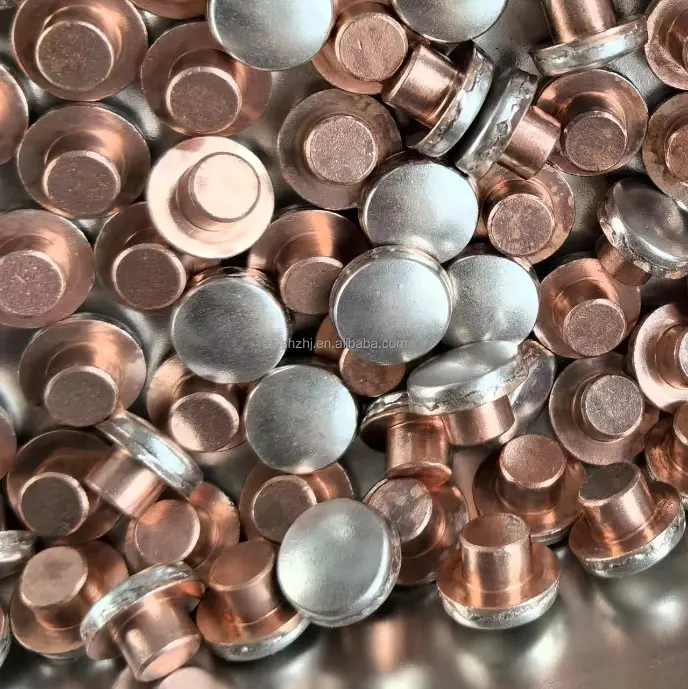
The cost-effectiveness of bimetallic composite rivets does not come at the expense of quality; rather, it is underpinned by a highly mature and efficient rivet manufacturing process system. The manufacturing process is centered around multi-station cold-heading technology. First, the silver alloy wire and copper-based wire undergo precision straightening and surface cleaning to remove oxide layers and contaminants, ensuring strong interfacial bonding. The two wires are then cut to preset lengths and sequentially fed into the die cavity at specific stations of the cold-header. In the first heading operation, the silver alloy and copper blanks undergo plastic deformation under immense impact force, with the contact surfaces achieving atomic-level diffusion and mechanical interlocking under high pressure, forming a robust metallurgical bond interface without visible gaps or oxide inclusions. Subsequent forming stages gradually shape the head geometry, shank diameter, and contact face spherical radius, completing the final rivet profile. The entire cold-heading process is conducted at room temperature without heating, which not only prevents high-temperature oxidation damage to material properties but also significantly increases production throughput—a single machine can produce several hundred finished rivets per minute. After forming, the rivets undergo vibratory finishing to remove edge burrs, followed by rigorous optical sorting and dimensional inspection to ensure that critical parameters such as head height, shank diameter, overall length, and silver layer thickness all comply with specification requirements. For high-end applications, a stress-relief annealing step may be added to eliminate internal stresses from cold working, enhancing dimensional stability during subsequent automated assembly. The high degree of automation and standardization throughout this process enables bimetallic rivets to maintain consistent quality while effectively controlling unit costs in mass production.
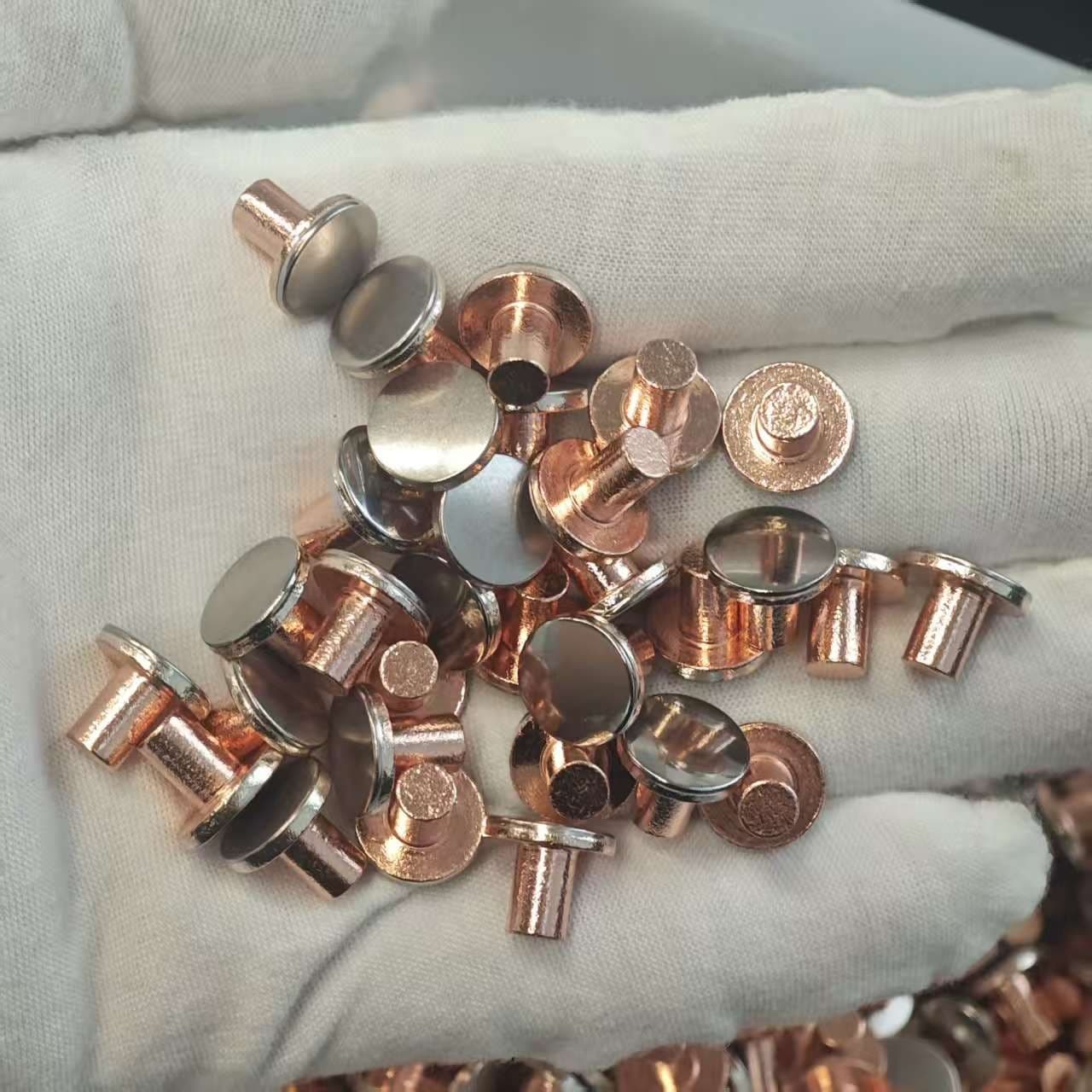
Compared with triple-composite and homogeneous (single-material) rivets, bimetallic composite rivets offer irreplaceable advantages in specific application scenarios. First, relative to homogeneous rivets, the advantages are clear: while homogeneous silver alloy rivets offer excellent electrical performance, the high cost of silver and its relatively low hardness make them prone to excessive upsetting deformation during riveting, compromising assembly precision. Homogeneous copper rivets, though low-cost and highly conductive, cannot withstand arc erosion during electrical switching, resulting in extremely short contact life. Bimetallic composite rivets strategically place the silver alloy “where it counts”—confining the precious metal to the working face while using copper as the load-bearing substrate—thereby maintaining electrical contact life while reducing material costs to 40%–60% of those of solid silver rivets, achieving an optimal balance between performance and cost. Second, compared with triple-composite rivets, bimetallic rivets may appear functionally simpler—for instance, they lack the iron layer at the tail that optimizes welding characteristics—but this “one-less-layer” structure brings a range of supply chain advantages, including simpler production processes, longer tool life, fewer quality control points, and shorter lead times. For medium-to-low-end electrical products that do not require welding or have modest high-temperature deformation resistance requirements, bimetallic composite rivets fully satisfy performance needs while avoiding the added manufacturing complexity and cost associated with triple-composite structures. Furthermore, bimetallic composite rivets have only one composite interface, resulting in lower interfacial thermal stress mismatch risk compared with triple-composite structures, and demonstrate superior interfacial reliability under thermal cycling conditions. Therefore, although bimetallic composite rivets may appear “modest,” they represent a mature solution that has been validated through long-term industrial practice, combining reliability with economy—an irreplaceable “backbone” in the field of electrical contacts.
Post time: Aug-10-2026